Nils-Petter was commissioned by OTW to create a third illustration in Trelleborg’s “Trelleborg in…” series, titled “Trelleborg in China.” The artwork is part of an ongoing corporate storytelling and editorial illustration concept, where each illustration highlights the company’s operations in a specific country. For this illustration, the client wanted an eye-catching hero illustration to showcase seven of the company’s manufacturing facilities located in Shanghai (上海), Qingdao (青岛), Wuxi (无锡), Suzhou (苏州) and Pinghu (平湖) — spanning distances of roughly 100–1,000 kilometres across eastern China.
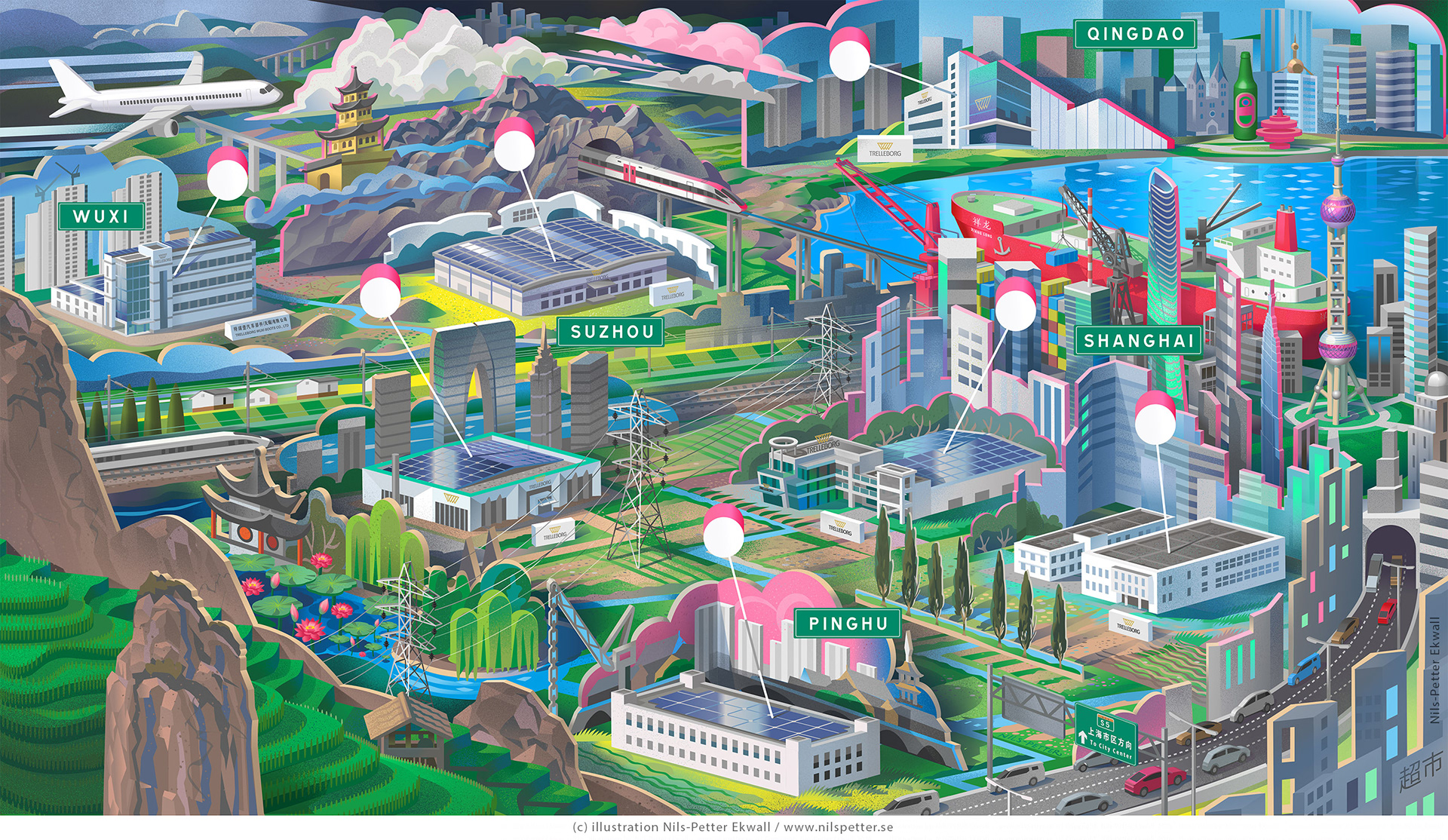
Trelleborg in China – Full Illustration Overview A large-scale editorial hero illustration and corporate storytelling piece visualizing Trelleborg’s industrial footprint across China. The composition merges multiple geographically distant manufacturing sites into a single continuous Chinese industrial cityscape, blending infrastructure, urban development, and production environments into one unified urban landscape visualization. Created as a detailed vector illustration in Adobe Illustrator for OTW and Trelleborg’s digital “T-time” hub.
Nils-Petter proposed presenting Trelleborg’s widely distributed manufacturing facilities as one continuous industrial landscape rather than a geographically accurate map. Inspired by the rapid transformation of eastern China, the concept conveys the feeling of a vast industrial mega region, where manufacturing, logistics, infrastructure and urban growth become part of the same evolving landscape. This approach allowed geographically distant locations to coexist within a single panoramic hero illustration, strengthening both the visual narrative and the company’s industrial story.
The highly detailed vector illustration was created in Adobe Illustrator, presenting a stylised Chinese industrial landscape. To integrate Trelleborg’s widely distributed operations, the map has been intentionally reoriented and visually compressed, allowing geographically distant sites to coexist within a single cohesive panorama. This transforms the work into a conceptual industrial landscape visualization, where spatial accuracy is secondary to narrative clarity and brand storytelling. The composition subtly “bends” the geography, allowing factories across China to be read as part of one continuous system rather than separate locations. Compared to its predecessors, the piece introduces a higher level of detail, expanding the narrative with more locations, sites and industrial scenes, resulting in a richer and more complex visual ecosystem.
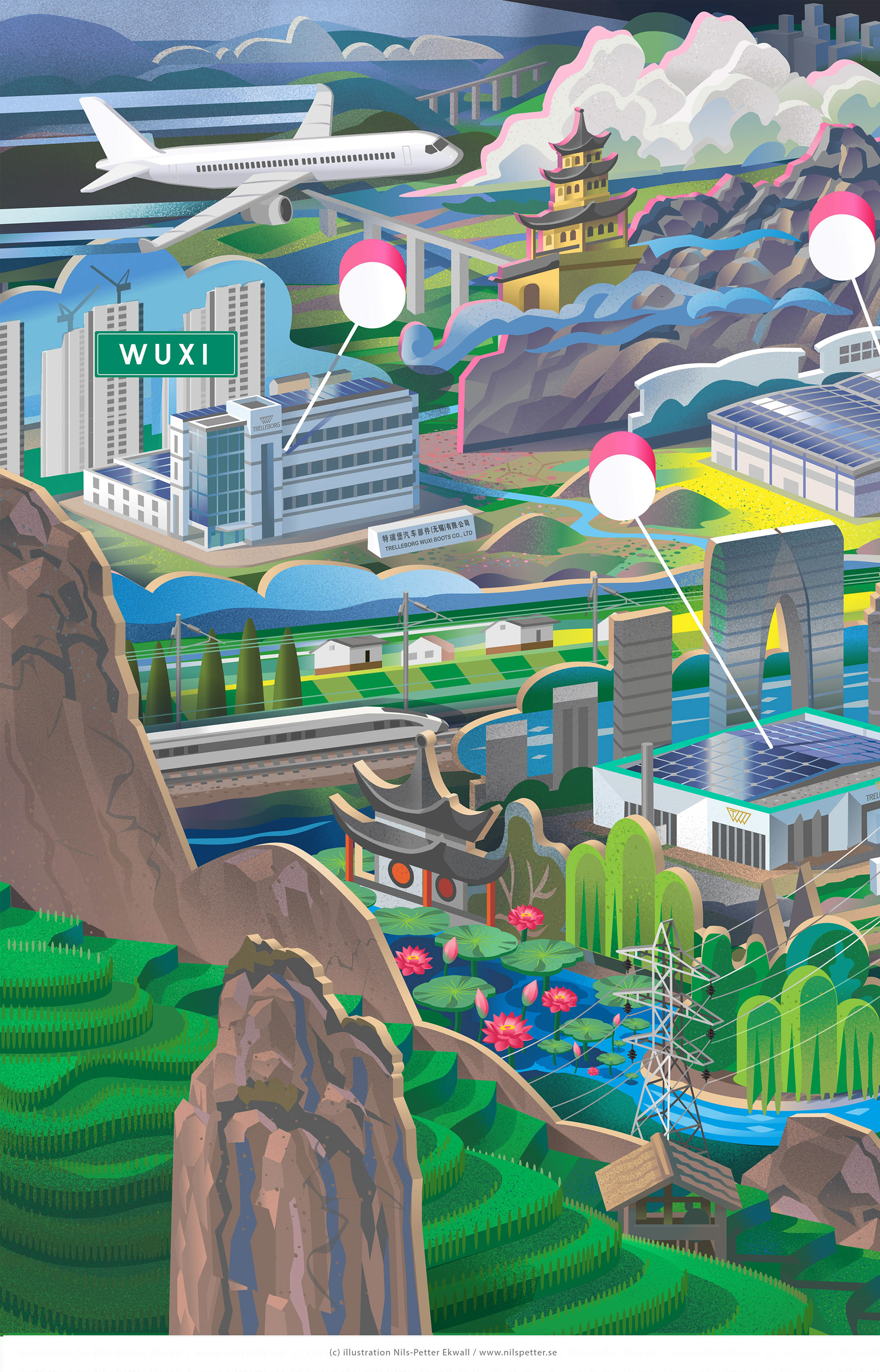
Detail of the full illustration. The foreground shows stylised mountains and rice terraces inspired by rural Zhejiang province.
Behind it, the scene shifts into Suzhou’s landscaped gardens, referencing classical Chinese garden design, followed by the TSS Suzhou factory and a wider transport corridor featuring high-speed rail infrastructure, the industrial city of Wuxi, aviation movement, and surrounding mountainous terrain.
While developing the illustration, Nils-Petter’s research into reference material revealed the scale and speed of the ongoing transformation of infrastructure and industrial development in China. Reference photos just a few years old would show newly planted forests or undeveloped land, while more recent images of the same location revealed dense urban environments with skyscrapers, residential districts, and large-scale infrastructure accommodating thousands of residents. This rapid pace of change became an important underlying narrative layer in the illustration, reinforcing the sense of a constantly evolving complex Chinese industrial landscape.
Due to strict regulations governing the commercial use of national symbols, Chinese flags were intentionally excluded from the illustration.

Detail of the illustration. From foreground to background: the TMS Pinghu factory set within compressed countryside, transitioning into peri-urban land between expanding cities, followed by the Shanghai industrial zone, the urban core of Suzhou with the Gate to the East financial district, the TSS Suzhou facility, and finally high-speed rail infrastructure connecting the region.
Featured manufacturing operations include Boots: Wuxi (automotive boots for the automotive industry), TMI Qingdao (marine and infrastructure solutions including mooring, berthing systems, solid fenders, gaskets and immersed tunnels), TSS Shanghai (sealing solutions for aerospace, semiconductor and industrial applications), TSS Suzhou (industrial sealing solutions), TMS Shanghai and TMS Pinghu (medical and respiratory technology solutions), and TAVS Suzhou (anti-vibration systems for off-highway, railway and renewable energy sectors). Together, these sites form a unified corporate communications design piece, an illustrated landscape - connecting diverse industrial sectors into a single visual ecosystem that communicates scale, precision, and global reach.
Trelleborg is a global leader in engineered polymer solutions, delivering advanced rubber and plastic applications across industries and operating in approximately 40 countries worldwide.
Illustration: Nils-Petter Ekwall
Agency / Project Management / Editorial: OTW – Tora Dahlström
Client: Trelleborg – Tobias Rydergren, Vice President Communications
Content, Writing & Research: Jan Hökerberg, Bamboo Business Communications
Agency / Project Management / Editorial: OTW – Tora Dahlström
Client: Trelleborg – Tobias Rydergren, Vice President Communications
Content, Writing & Research: Jan Hökerberg, Bamboo Business Communications

Detail of the illustration. Foreground: expressway leading into Shanghai and the TMS Shanghai facility. Midground: Shanghai skyline featuring Shanghai Tower (上海中心大厦), Oriental Pearl Tower (东方明珠塔), Jin Mao Tower (金茂大厦), and Shanghai World Financial Center (上海环球金融中心), surrounded by dense port infrastructure, cranes, and active shipping across the bay. Background: the coastal transition toward Qingdao including the TMI Qingdao facility, maritime industry zones, the Red Spiral sculpture at May Fourth Square, and St. Michael’s Cathedral (圣弥厄尔主教座堂), as well as contextual beer industry references such as beer bottles associated with Qingdao’s brewing industry (青岛啤酒), linking urban development with coastal industrial production across an interconnected industrial landscape.

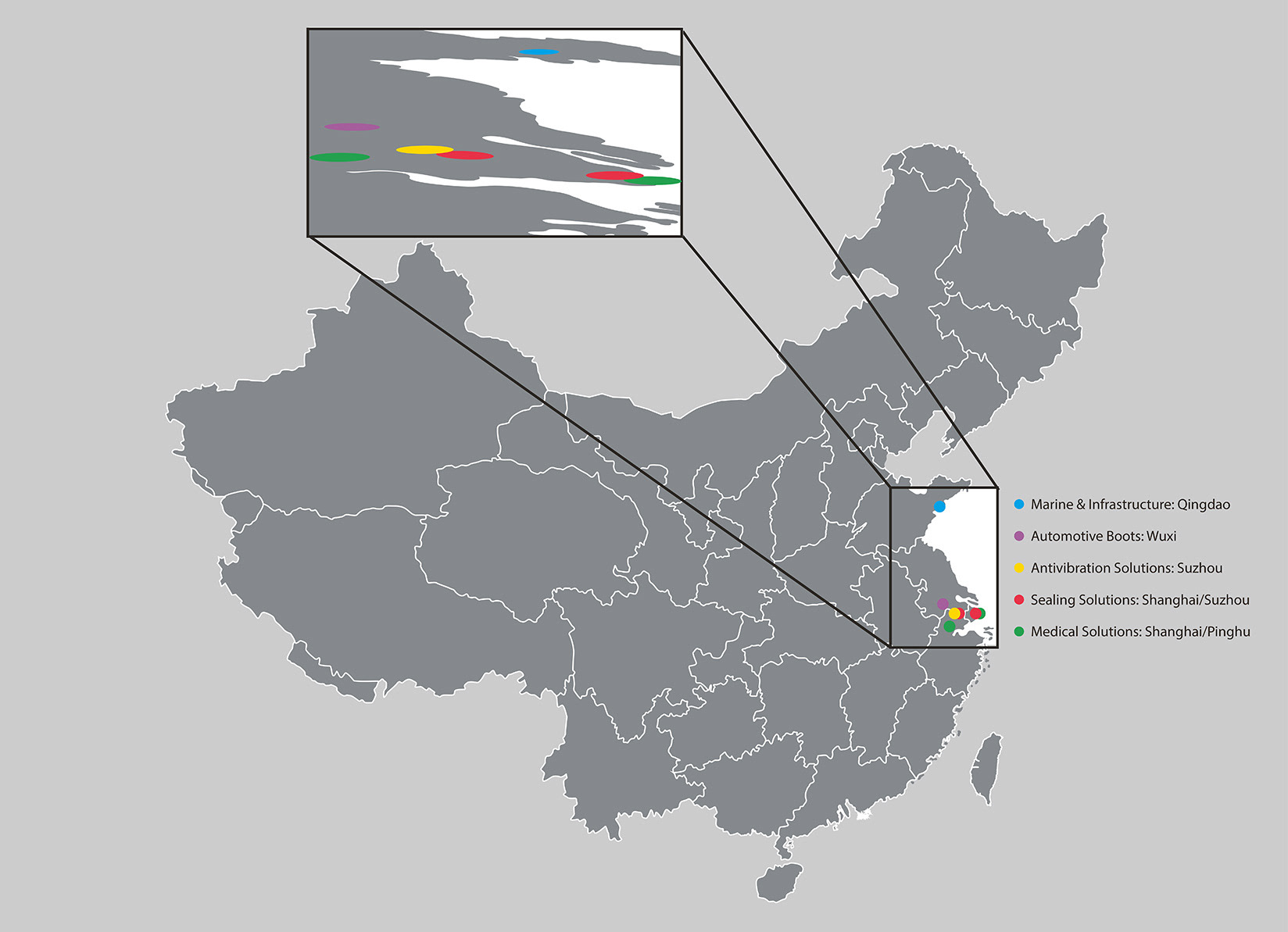
Left image: Reference imagery showing factory sites and their geographical locations across China, forming the basis for the illustrated map and company illustration concept. Finding suitable reference material was challenging due to limited Google Street View coverage in China and Chinese-language mapping tools such as Baidu Maps.
Right image: Intentionally reoriented and compressed illustrated map of China, visualizing Trelleborg’s industrial operations in a continuous company illustration across key manufacturing locations. The illustrator adjusted the geography to bring a spread-out network together into a single illustration.
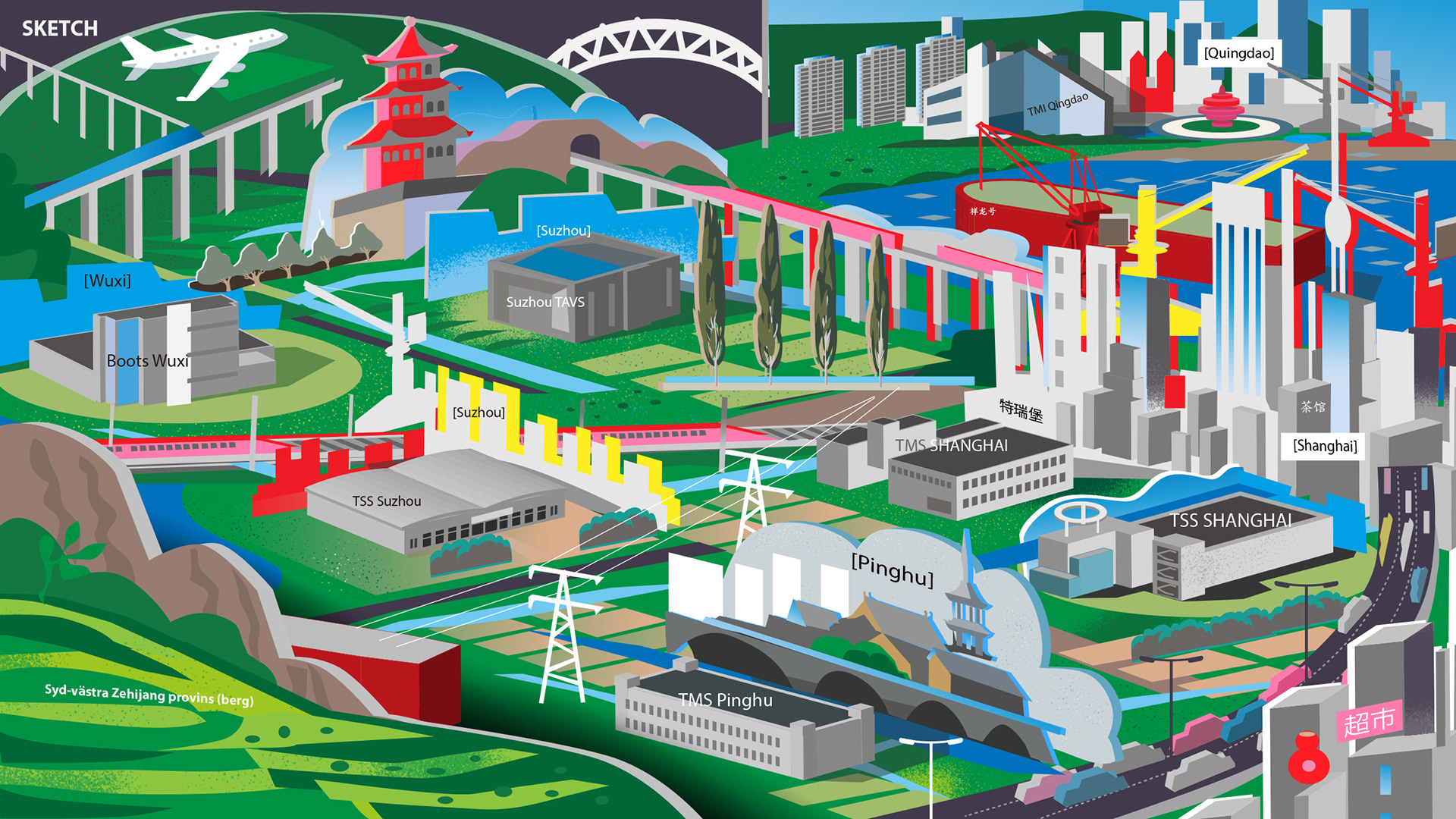
Initial layout sketch created directly in Adobe Illustrator, developed as an early visual proposal for the client to communicate overall composition, scope, and placement of key elements. The sketch outlines the spatial structure of the illustration, including the positioning of major industrial sites, urban areas, and infrastructural connections across the composition, serving as a foundation for the final detailed artwork.
–––––––––––––––– Trelleborg in the US. Second illustration in the series. ––––––––––––––––
Read more here:

”From the dense forests of Alaska to the rolling prairies of North Dakota, and from the chilly peaks of the Rocky Mountains to the tropical climates of Florida, the United States' diverse weather conditions create unique opportunities for Trelleborg's products and solutions."
Nils-Petter was commissioned to create a spectacular illustration for Trelleborg's brand-building publication, T-time Magazine, and its "Trelleborg in..." series, where each illustration highlights the company's operations in a specific country. For this second in the series, the client wanted an eye-catching three-page-wide fold-out illustration to showcase a selection of the company's products in use across the United States.
The Brief. The client's brief outlined the depiction of multiple scenes from across different states – locations with entirely different climates and contexts—such as prairies, deserts, the Rocky Mountains and subtropical areas. The image was going to be used for a
3-page wide fold-out – to create a little wow factor as the reader unfolded the spread – discovering that Trelleborg's products are found everywhere across the US continent (and indeed the entire world).
Concept. To fit everything in – and to elevate the impact of a luxurious fold-out –
Nils-Petter thought of a concept where the illustration itself borrowed character from the folded paper of the spread, integrating the very folds and creases into the design to create a sense of depth and dimension.
The different geographic locations were sketched as flat landscapes on backdrops, panels, and props, set in a semi-isometric perspective. In this way, they could be placed closely together to save space and serve as clear dividers between the different climate zones and scenes that the client wanted to communicate.
All of this was constructed like a bouquet – with the Trelleborg facility at the center and the backdrops surrounding it, making the spread itself feel like a faux paper pop-up when the page is unfolded. These deliberate design choices would hopefully give the piece a bit of a layered, multidimensional quality, as though the page was coming to life.
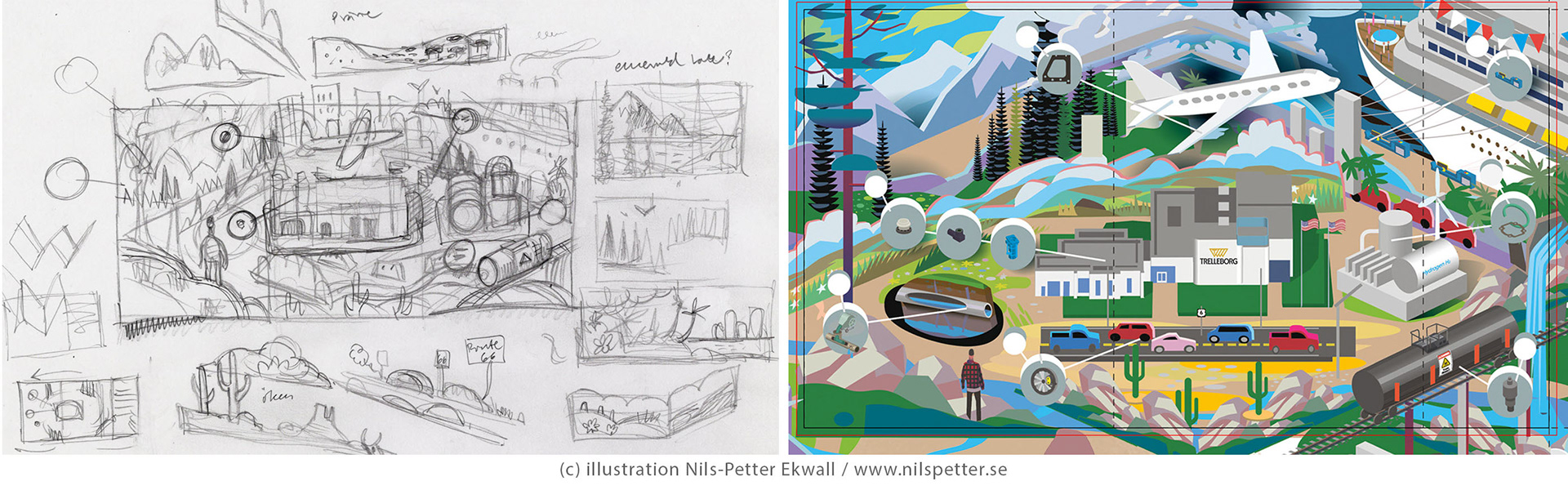
1. Initial thumbnail sketches 2.The first concept shown to the client was made in Adobe Illustrator
enabling the flexibility to move objects around and adjust the layout as needed.
Sketch and Research. After Nils-Petter researched references for landmarks and the geographical locations using Google Street View – along with some additional Americana references – Nils-Petter began to sketch out the image in Illustrator, working within the given format (3 pages – 495 x 278 mm). Here, the delicate work of laying out the different parts of the image began – ensuring everything came together seamlessly with the infographics and visual cues.
Illustration. After the sketch was approved by the client, Nils-Petter began to render – building up the illustration piece by piece. This was the most time-consuming part of the production process. But here, the client wanted something unique and hand-made. The attention to detail in an illustration adding depth and character, creating a more authentic and memorable artwork that would stand out, offering a distinctive, lasting impression that reflects a brand’s commitment to excellence.
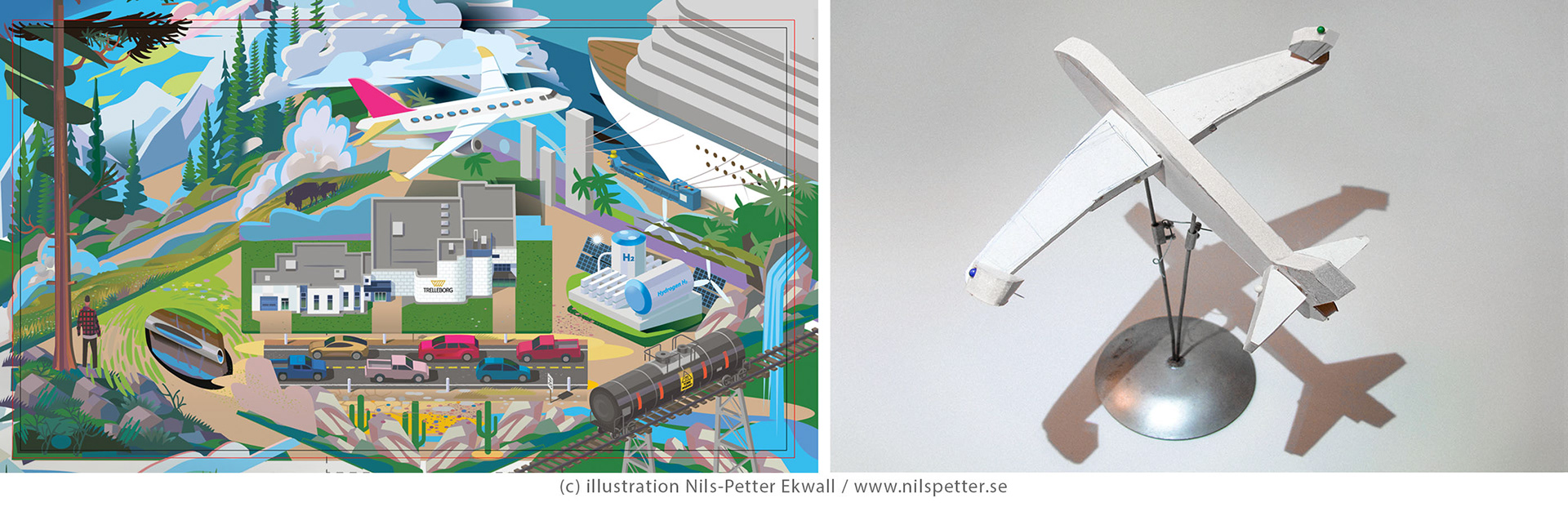
3. Work in progress. Piece by piece, the objects are rendered. 4. A quick cardboard maquette of the airplane
to use with a flashlight for shadow studies.
Finalizing. In the final stages of the process, Nils-Petter introduced an additional layer of realism and complexity: shadows and atmosphere. Here, Nils-Petter created quick cardboard maquettes of the airplane and a few decorative elements to use with a flashlight in order to determine how shadows would fall naturally. (Cutting cardboards was a welcome break from many hours in front of the computer screen.) The final touch was working with textures and atmosphere before sending the completed image to the client.
T-Time magazine is published in English, German, Swedish, French, Spanish and isdistributed to Trelleborg customers and shareholders, investors and analysts worldwide.
Trelleborg is a world leader in engineered polymer solutions that protect advanced applications in challenging operating conditions. Its innovative solutions accelerate performance for customers in a sustainable way. The Trelleborg Group had annual sales of about SEK 34 billion in 2023 and operations in about 40 countries. The Trelleborg share has been listed on the Stock Exchange since 1964 and is listed on Nasdaq Stockholm, Large Cap. www.trelleborg.com
Client: Trelleborg
Illustrator / illustratör: Nils-Petter Ekwall
Graphic Design: Markus Ljungblom (Appelberg)
Publishing Agency: Appelberg
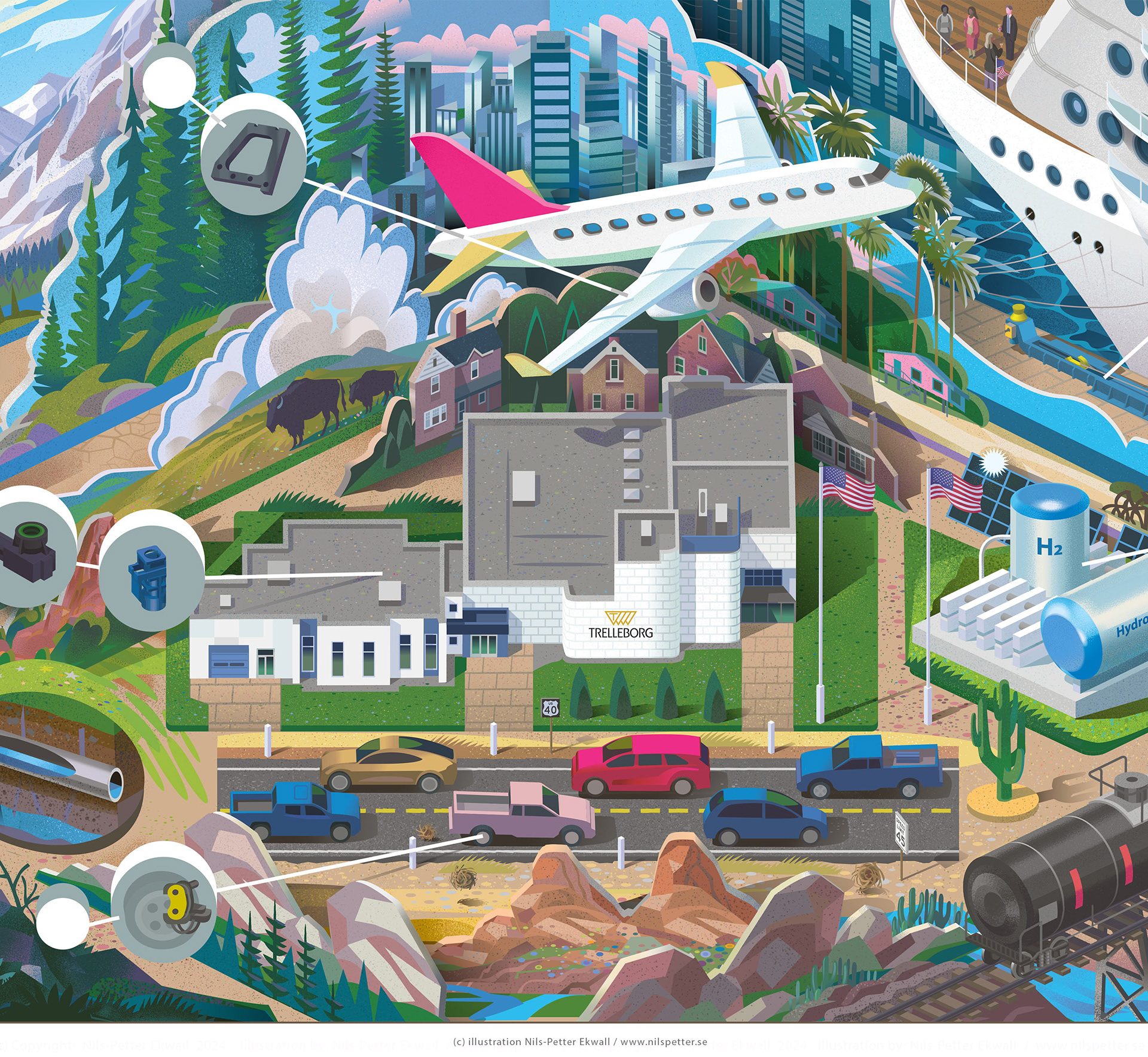
Center piece of the illustration - Trelleborg’s Innovation Facility in Plymouth, Minnesota. One of eleven Trelleborg facilities in the U.S. dedicated to the healthcare and medical industry. (The Innovation Center comprises several core competencies critical to medical device and pharmaceutical component development, including design, consultation, toolmaking, prototyping, high-precision machining, silicone molding, thermoplastic molding, automation, assembly, and secondary operations.)
Top of the image: Trelleborg’s advanced composites fuse layers of material to create durable structures for aircraft. replacing aluminum parts, reducing weight, lowering fuel consumption, and allowing for more passengers.

Trelleborg’s Innovation Facility in Plymouth, Minnesota as a stand alone cut-out illustration.
Top right corner: Trelleborg’s mooring solutions accommodate a largest cruise ship in the Port of Miami. Middle right: A new testing facility in Indiana is dedicated to the development of specialized H2Pro™ materials for the hydrogen industry. Bottom right corner: Trelleborg’s O-rings and gaskets ensure the safe transport of hazardous chemicals by train through sensitive natural areas. Bottom left corner: Trenchless pipe rehabilitation seals sewers from the inside using a polymer liner, preventing pollution from seeping into groundwater. This no-dig method minimizes disruption to communities, traffic, and the environment.
Bottom center: U.S. Highway 40 – Brake shims are one of Trelleborg’s many products used within the automotive industry.

U.S. Highway 40 as a stand alone cut-out illustration.
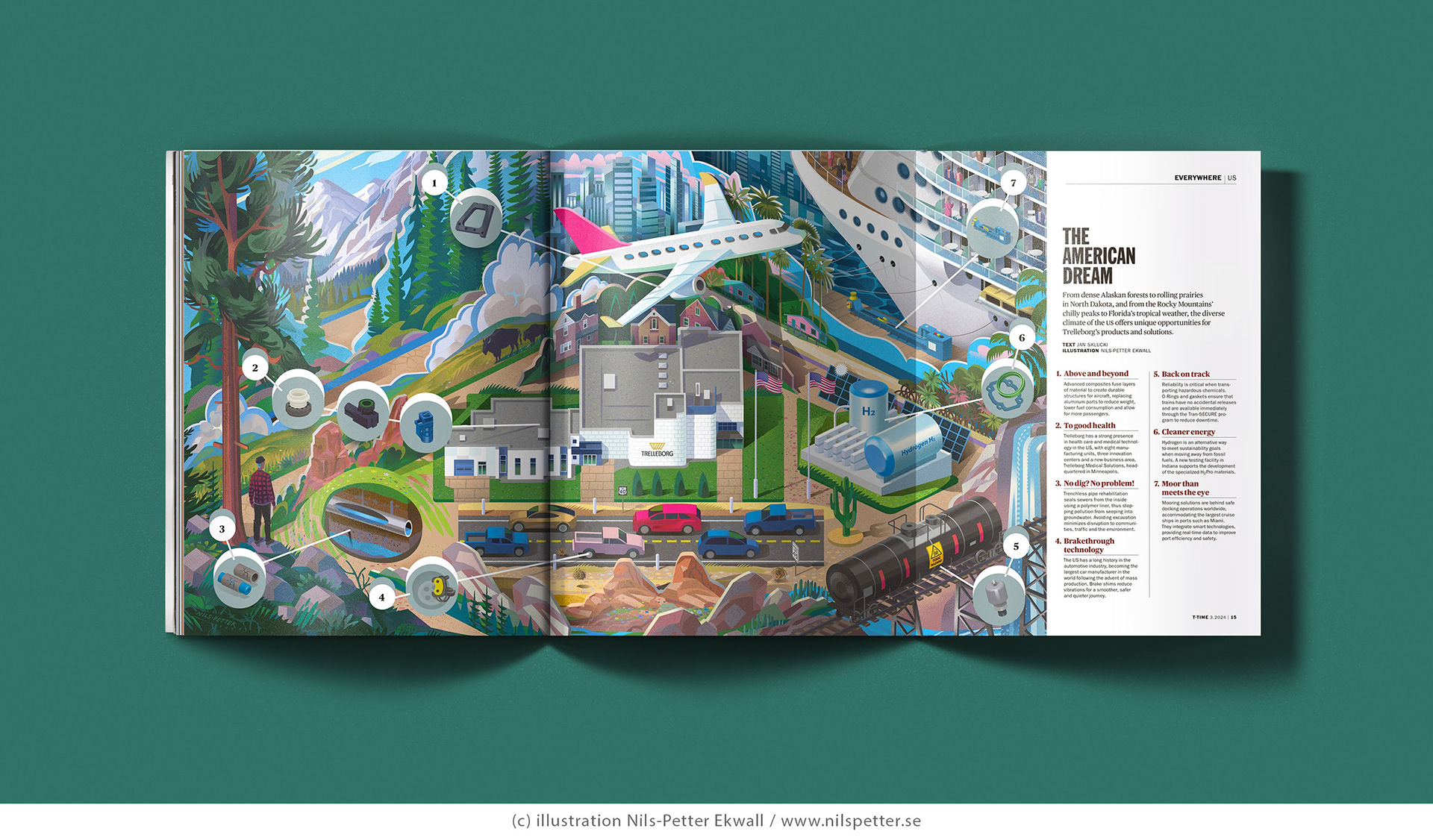
The finished illustration in use on the 3-page wide fold-out, together with the legend. T-Time #3-2024
–––––––––––––––––– Trelleborg in India. First illustration in the series. ––––––––––––––––––
Read more here:
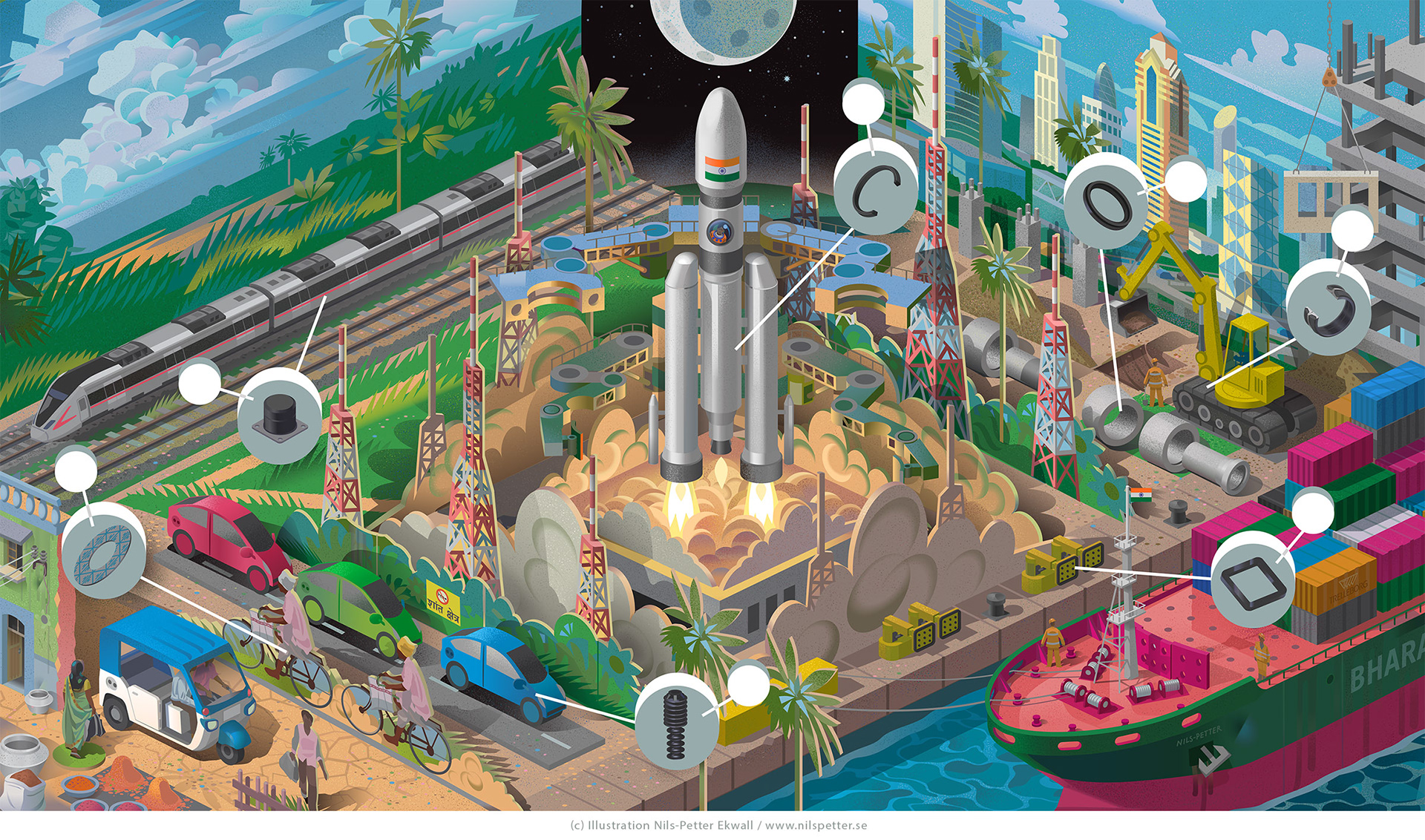
Trelleborg in India. First illustration in the series.
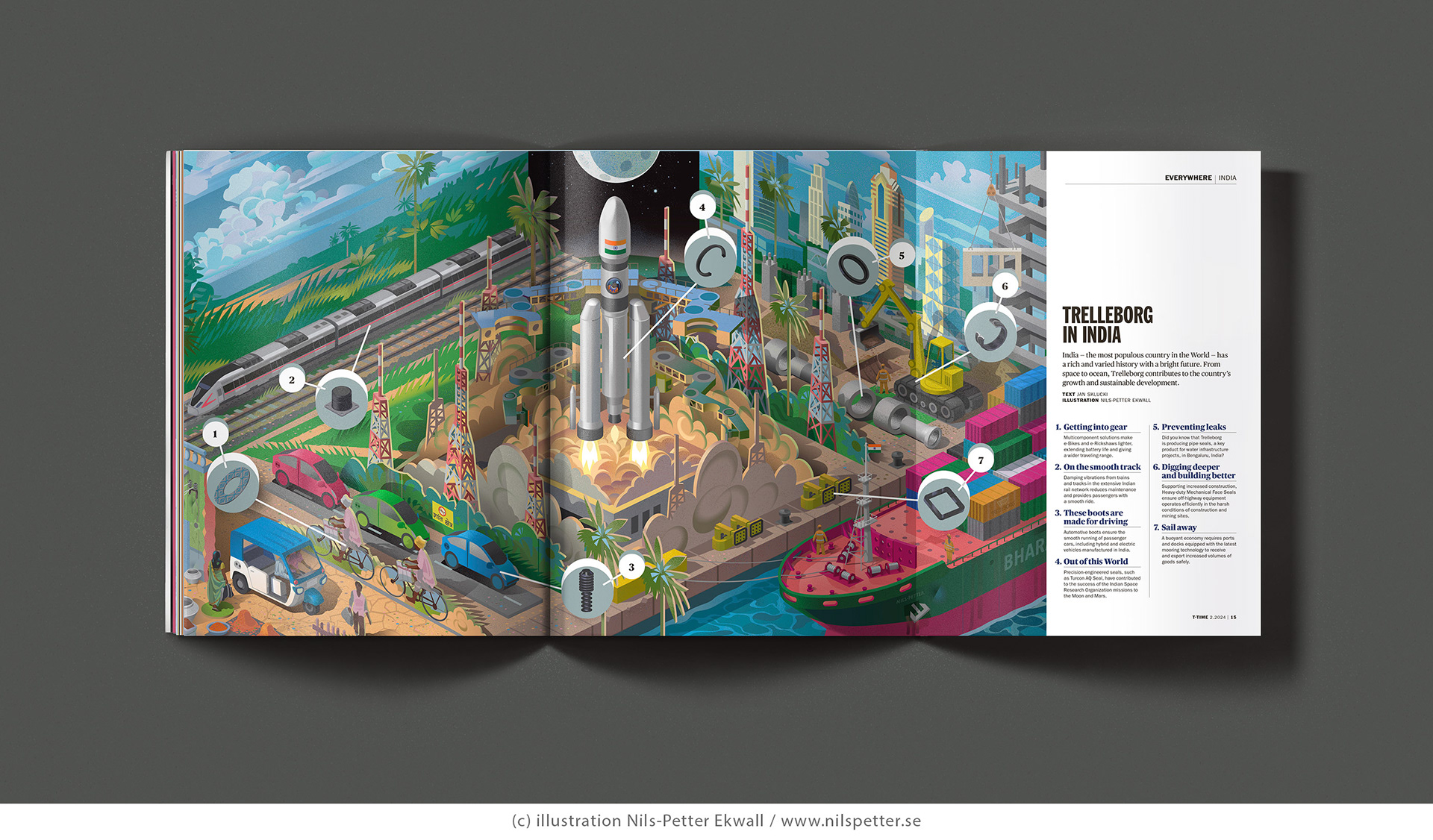
The finished illustration in use on the 3-page wide fold-out, together with the legend. T-Time #2-2024
En kort sammanfattning på Svenska: Illustratören Nils-Petter, baserad i Stockholm, fick i uppdrag av Appelberg att skapa en spektakulär illustration för Trelleborgs varumärkesbyggande tidning, T-time Magazine. Uppdraget var att visa företagets produkter i användning över USA på ett imponerande 3-sidig uppslag. Illustrationen skulle spegla olika klimatzoner som prärie, öken och bergsområden. Genom att använda Illustrator och referenser från Google Street View skapade Nils-Petter en illustration där landskapen placerades nära varandra för att spara plats och ge en känsla av djup. Slutligen lades skuggor och atmosfär till för att skapa realism. Resultatet blev en unik och handgjord illustration som ger ett bestående intryck av Trelleborgs engagemang för kvalitet.
Kund: Trelleborg
illustratör: Nils-Petter Ekwall
Grafisk design: Markus Ljungblom (Appelberg)
Publishing Agency: Appelberg